

Lord Krishna Statues
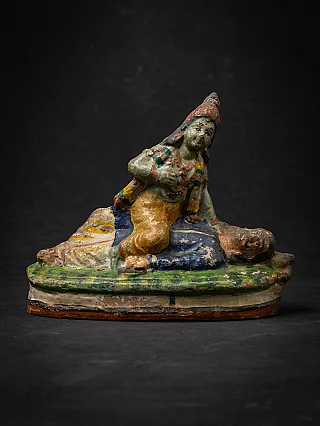
Krishna occupies a place in Hindu devotional life that no other deity quite matches. He is the cowherd boy who enchants all of Vrindavan with his flute, the young warrior who counsels Arjuna on the battlefield of Kurukshetra, the divine child stealing butter from his mother's kitchen, and the supreme cosmic lord who reveals himself as the source of all existence. He contains all of these at once, which is why Krishna statues have been produced continuously across India, Nepal, and Southeast Asia for well over a thousand years, in materials ranging from bronze and stone to wood and ivory. At Original Buddhas, our collection of Krishna statues brings together antique and vintage pieces from the great sculptural traditions of India and Nepal, selected for their iconographic integrity, carving or casting quality, and the individual warmth and vitality that the finest Krishna figures carry.
Who is Krishna -- theology, devotion, and the Vaishnava tradition
Krishna is the eighth avatar of Vishnu according to the mainstream Vaishnava theological framework, though in the traditions of Vaishnavism that specifically elevate Krishna (particularly the Gaudiya Vaishnava tradition founded by Chaitanya Mahaprabhu in 16th century Bengal), he is understood not as a secondary figure but as Svayam Bhagavan -- the original form of the divine from whom Vishnu himself derives. This theological position, articulated most fully in the Bhagavata Purana (compiled approximately 9th to 10th century CE), makes Krishna one of the most theologically complex and devotionally rich figures in the entire Hindu tradition.
The primary sources for Krishna's mythology are the Mahabharata (particularly the Bhagavad Gita, which takes place during the great war), the Harivamsa (an appendix to the Mahabharata dealing specifically with Krishna's birth and childhood), and the Bhagavata Purana (especially its tenth book, the Dasama Skandha, which contains the most detailed account of Krishna's life in Vrindavan). The Gita Govinda, composed by the poet Jayadeva in 12th century Bengal, established the devotional poetry of Krishna's love for Radha that has profoundly shaped the aesthetic of Krishna sculpture and painting ever since.
What distinguishes Krishna from most other Hindu deities in sculptural terms is the emotional register he invites. Where Shiva statues convey awe, cosmic power, and the terror of the absolute, and Vishnu statues carry the formal authority of the cosmic preserver, Krishna statues are often characterised by warmth, grace, and what the devotional tradition calls madhurya -- sweetness. The great Krishna sculptures from Rajasthan, Mathura, and the Deccan do not simply depict a deity; they invite a feeling of personal intimacy with the divine that is quite different from the experience of standing before a great Shiva or Vishnu figure.
The major iconographic forms of Krishna statues
Krishna appears in more iconographic forms than almost any other Hindu deity, reflecting the richness of the mythological tradition surrounding him. Each form has its own identifying attributes, its own emotional character, and its own regional sculptural tradition.
Venugopala -- Krishna the flute player
The Venugopala form (Sanskrit: "the cowherd who plays the venu flute") is the most beloved and widely reproduced Krishna iconographic type. It shows Krishna standing in the tribhanga posture -- the triple bend of head, torso, and legs that gives Hindu sculpture its characteristic sensuous, swaying quality -- with a flute held to his lips, his weight shifted to one hip, one foot crossed in front of the other. This posture, which has no parallel in Buddhist iconographic traditions, is one of the most recognisable in all of Asian sacred art.
The tribhanga posture is not simply aesthetic. It expresses the quality of lila, the divine play that Krishna embodies -- the idea that cosmic creation and sustenance are not heavy burdens but a joyful, graceful activity that the divine undertakes with the ease of a musician absorbed in his playing. In the great stone Venugopala sculptures from Rajasthan, Karnataka, and Orissa, this quality of relaxed divine joy is achieved through proportional refinement and surface quality that took the best workshops centuries to perfect.
The flute itself (bansuri or venu) is Krishna's primary identifying attribute and carries specific theological meaning. In the Bhagavata Purana, the sound of Krishna's flute is described as so irresistible that it draws all beings toward him -- the gopis (cowherd women) abandon their households to follow it, the cows raise their heads from grazing, the trees bend toward its sound. The flute represents the divine call that draws the individual soul toward the universal. In antique Krishna statues, the presence and condition of the flute are important assessments -- it is the most frequently damaged element in standing Venugopala figures.
Bal Krishna -- the divine child
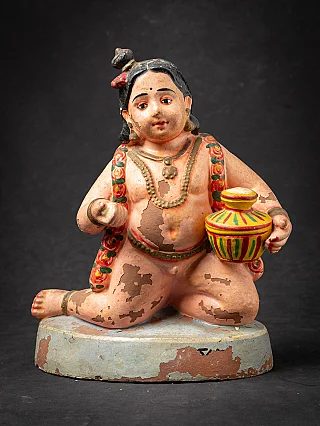
Bal Krishna (the child Krishna) depicts the god in infancy and childhood -- crawling, dancing, or more commonly in the iconic pose of the Makhan Chor (the butter thief), sitting with one hand dipping into a pot of butter and the other raised with a ball of butter, his face showing the pleased expression of a child who knows he is doing something he should not. This iconographic type is one of the most widely produced in Indian devotional art and one of the most endearing.
The theological depth behind this apparently simple image is considerable. The butter stealing stories (found in detail in the Bhagavata Purana's tenth book) are understood in the devotional tradition as expressing the irresistible nature of divine love -- Krishna steals butter just as he steals the hearts of his devotees, and the mother Yashoda's mixture of exasperation and helpless love for the child represents the devotee's experience of bhakti (devotional love). In antique bronze Bal Krishna figures from South India and Rajasthan, this emotional complexity is expressed through extraordinary subtlety of facial expression -- a technical challenge that separates the great workshop pieces from the ordinary.
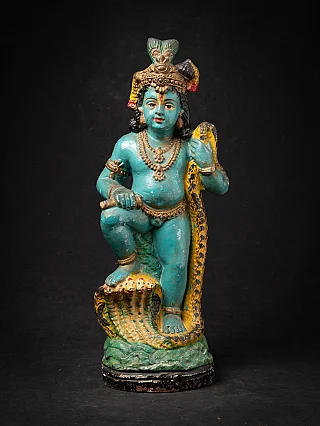
Another important Bal Krishna iconographic type is the Kaliya Daman -- the young Krishna dancing on the hood of the great serpent Kaliya, whom he has subdued and driven from the river Yamuna that Kaliya had been poisoning. This form shows the child Krishna in a dancing posture atop a multi-headed serpent, and appears particularly in South Indian bronze and stone sculpture.
Govinda and Gopala -- the cowherd forms
The Govinda and Gopala forms show Krishna in his role as a cowherd in Vrindavan, often with cows around him or with a calf held in one arm. These forms are closely related to Venugopala but emphasise the pastoral setting -- Krishna as the divine protector of the natural world, the land, and all living creatures. The Govinda temples of Vrindavan (particularly the Govindadeva temple built in the 16th century under Mughal patronage) established a formal iconographic type that has shaped devotional sculpture and painting across northern India ever since.
Radha-Krishna -- the divine couple
Radha-Krishna sculptures depict Krishna together with Radha, his consort and the supreme devotee in the Vaishnava tradition. Radha does not appear in the earliest Krishna texts but is central to the Gita Govinda and the subsequent devotional tradition, particularly in Bengal and Vrindavan. In sculptural terms, Radha-Krishna compositions show the two figures standing together -- often with their arms around each other, Radha slightly smaller and to Krishna's left -- in a pose of intimate union that expresses the theological concept of the union between the individual soul (Radha) and the divine (Krishna).
In antique Radha-Krishna bronzes from Rajasthan and the Deccan, and in stone sculptures from Orissa and Karnataka, this pairing produces some of the most graceful compositions in Hindu sacred art. The quality indicators for Radha-Krishna pieces are demanding precisely because two figures must be in perfect compositional relationship -- the positioning of the arms, the turn of the heads, and the proportional relationship between the two figures all contribute to whether the composition works as a unified image of devotional love.
Krishnarjuna or Parthasarathi -- Krishna as charioteer
The Parthasarathi form (literally "the charioteer of Partha" -- Partha being another name for Arjuna) shows Krishna in his role as Arjuna's charioteer during the battle of Kurukshetra, as described in the Mahabharata and the Bhagavad Gita. This form typically shows Krishna holding the reins of horses, sometimes with a conch shell (Panchajanya), the weapon he blows before battle, and occasionally with a whip. This iconographic type is most common in South India, particularly in Tamil Nadu and Andhra Pradesh, where Parthasarathi temples maintain this specific form of Krishna worship.
Reading Krishna's attributes and iconographic details
Understanding the attributes that appear with a Krishna figure is essential for identifying the form and assessing the iconographic completeness of a sculpture.
The flute (bansuri or venu) is the primary attribute of the Venugopala form and the most immediately identifying detail. The peacock feather (morpankh) worn in Krishna's crown or hair is the second most important identifying attribute -- it is described in the Bhagavata Purana as a gift from the peacocks of Vrindavan and is among the most characteristic details in virtually all Krishna sculpture regardless of regional tradition. The colour of Krishna's skin, described in the texts as shyama (dark blue or blue-black, like a rain cloud), is expressed in sculpture through the material itself -- dark stone, patinated bronze, or painted surface -- and is one of the ways in which antique pieces are distinguished from modern reproductions, which sometimes misread the iconographic convention.
The crown (mukuta) of a Krishna figure is typically more elaborate than those worn by other Vaishnava forms -- often showing the kirita mukuta (a tall, tapering crown) combined with the peacock feather. The yellow dhoti (pitambara) is the canonical garment of Krishna, described in the texts as saffron or yellow silk, and is expressed in stone sculpture through incised or carved garment lines. The garland of forest flowers (vanamala) that Krishna wears reaching to his knees, described in detail in the Bhagavata Purana, appears as an attribute in many formal sculptural types.
In his more formal Vishnu-related manifestations, Krishna may hold the conch (shankha), the discus (Sudarshana chakra), the mace (kaumodaki), and the lotus -- the four attributes of Vishnu. In these forms, the identification with Vishnu is explicit, and the iconography is more formal and hieratic than the warm, swaying Venugopala type.
Materials and regional traditions in Krishna sculpture
Krishna sculpture appears across the full range of materials used in Indian and Nepalese sacred art, and the regional traditions produce quite different visual characters from the same theological source.
Stone Krishna sculpture from India represents the oldest and most formally developed tradition. The great Mathura workshops of the Gupta period (4th to 6th centuries CE) produced the first canonical Krishna images in sandstone, establishing the tribhanga posture and the peacock-feather crown that all subsequent Krishna sculpture follows. Rajasthani sandstone Krishna figures -- particularly from the workshops associated with the great Vaishnava temple centres of Vrindavan and Nathdwara -- are among the finest stone Krishna sculptures available to collectors. Orissa produced a distinct regional type in chlorite schist and khondalite, characterised by elaborate surface decoration and the particular warmth of dark stone polished to a deep luster. South Indian granite and schist Krishna figures, from Tamil Nadu and Karnataka, tend toward more formal proportions and the frontal symmetry of the Dravidian temple tradition.
Bronze Krishna sculpture is most highly developed in South India -- the great Chola bronze workshops (9th to 13th centuries) that produced the canonical Nataraja also produced Venugopala, Bal Krishna, and Kaliya Daman bronzes of extraordinary quality. Chola Bal Krishna bronzes in particular -- small figures of the crawling or seated child with one hand raised holding butter -- are among the most sought-after pieces in any Indian bronze collection, combining technical mastery with an expressiveness of facial modelling that remains unmatched in the later tradition. Nepalese bronze Krishna figures from the Newar workshop tradition show the influence of both the Vaishnava theological tradition and the sophisticated Newar metalwork techniques -- mercury amalgam gilding, repoussé backgrounds, and the precise attribute placement required by the Agamic canons.
In the broader stone statues collection at Original Buddhas, Krishna figures appear alongside other Hindu deities in sandstone, schist, and occasionally lavastone from the Balinese tradition, where Krishna is less prominent than Shiva or Ganesha but appears in the context of the broader Vaishnava presence in Balinese Hinduism.
How to assess a Krishna statue before purchase
The first thing to establish is which Krishna form is depicted, because the quality criteria differ meaningfully between them. A Venugopala figure's quality lives primarily in the tribhanga posture and the face -- does the figure actually sway, or does it merely stand with a slight inclination? Is the face expressing something, or is it a competent but inert mask? A Bal Krishna figure's quality lives almost entirely in the face -- the expression of the child is the whole subject, and any flatness or schematism there is fatal to the piece. A formal four-armed Krishna figure stands or falls on the precision and elegance of the attribute placement and the proportional dignity of the overall composition.
The flute is the most vulnerable element in Venugopala figures -- it extends horizontally from the figure and breaks easily. Assess whether a missing flute is original to the piece or a later loss, and whether the hands are formed to hold a flute or have been adapted from a different iconographic type. Old losses of this kind are common in antique pieces and do not necessarily disqualify them, but they should be assessed honestly and reflected in the condition report.
For bronze Krishna figures, the casting quality of the face and hands is the primary indicator of workshop quality. In the finest South Indian Chola and post-Chola bronzes, the modelling of the eyelids, the transition between cheek and jaw, and the particular expression of the lips carry a life quality that is immediately perceptible and quite different from the flatter surface quality of later or lesser workshop pieces. The patina should show natural variation -- deeper and darker in recesses, lighter on high surfaces that have been handled -- rather than the uniform darkness of artificially aged pieces.
At Original Buddhas, every Krishna piece is described with a full condition report covering the iconographic form, attribute completeness, material and surface quality, patina or weathering, any losses or repairs, and the estimated period and region. Questions about any piece in the Krishna statues collection are always welcome.
Where to place a Krishna statue
Krishna statues are among the most versatile of Hindu deity figures in terms of placement, precisely because the character of the deity is warm and approachable rather than awesome or terrifying. A Venugopala figure works well in a living room or entrance where its graceful tribhanga posture and the feeling of joyful music can set the tone of a space. A Bal Krishna figure in the butter-stealing pose works well on a kitchen or dining room shelf, where the association with food and domestic abundance feels natural. A Radha-Krishna pair suits a bedroom or private sitting room, where the intimacy of the composition matches the character of the space.
For more formal arrangements, a stone or bronze Krishna figure on a dedicated altar table or wooden plinth, with a simple background of natural linen or pale plaster, creates the kind of focused, calm presentation that allows the quality of the piece to read clearly. Soft side lighting works best for stone figures, revealing carving depth and surface quality. Warm incandescent or LED light brings out the warmth and depth of bronze pieces. If the piece has gilded details, avoid very bright direct light, which flattens gilding and eliminates the sense of depth in the surface.
As with all Hindu deity statues, placement at or above eye level is respectful and appropriate. The floor is not a suitable surface for a devotional figure.
FAQ: Krishna statues
Who is Krishna and what makes him different from other Hindu deities?
Krishna is the eighth avatar of Vishnu in mainstream Vaishnava theology, and the supreme divine being in the Gaudiya Vaishnava tradition. He is unique among Hindu deities in the breadth of his mythological life -- from divine infant and mischievous child, to cowherd lover and divine musician, to warrior, king, and cosmic teacher. This breadth produces a wider range of iconographic forms than almost any other deity, and a quality of personal intimacy in devotional practice that distinguishes the Krishna tradition from the more formal bhakti of other Vaishnava forms.
What are the main Krishna iconographic forms and how do I identify them?
The most common forms in the antique sculpture market are: Venugopala (the flute player, standing in the triple-bend tribhanga posture with a flute at his lips); Bal Krishna (the divine child, typically seated and stealing butter); Govinda or Gopala (the cowherd, often with a calf or cows); Radha-Krishna (the divine couple, standing together); Kaliya Daman (the child Krishna dancing on the serpent Kaliya); and the formal four-armed Vaishnava type (holding conch, discus, mace, and lotus, closely related to Vishnu iconography). Each is identified by its posture, attributes, and facial character.
Why is Krishna depicted with blue or dark skin?
The texts describe Krishna's skin colour as shyama -- a Sanskrit word meaning dark, specifically the deep blue-black of a rain cloud. This colour is theologically significant: rain clouds bring life-giving water, and the dark colour is associated with infinity, depth, and the quality of the divine that exceeds ordinary human perception. In stone sculpture, dark stones such as black schist, chlorite, or darkened sandstone are preferred for Krishna images precisely because they express this quality. In bronze sculpture, the natural darkening of patina expresses the same quality. In modern painting and popular imagery, shyama is rendered as vivid blue, which is a later convention not found in the great antique sculptural tradition.
Are Krishna statues at Original Buddhas antique?
The majority of Krishna statues in the Original Buddhas collection are antique (over 100 years old) or vintage (50 to 100 years old), from India and Nepal. Each listing specifies the estimated period, region, iconographic form, material, and condition clearly. We do not sell newly manufactured decorative reproductions.
What do Krishna statues cost?
Prices range from approximately 200 to 500 euros for smaller vintage devotional pieces in stone or bronze, to 1,500 to 6,000 euros for significant antique figures with strong iconographic completeness, fine workshop quality, and clear period attribution. Exceptional Chola-tradition South Indian Bal Krishna bronzes and high-quality Rajasthani sandstone Venugopala figures occupy the upper end of the range. Each piece is priced individually based on iconographic form, material, carving or casting quality, condition, period, and rarity.
Can Krishna statues be displayed by people who are not Hindu?
Yes. Krishna statues are collected, studied, and displayed by people of all backgrounds worldwide, as objects of artistic, spiritual, and historical interest. The primary consideration is respectful placement -- at or above eye level, on a dedicated surface rather than the floor -- which is appropriate regardless of the collector's religious background. Many non-Hindu collectors are drawn to Krishna figures specifically for the warmth and joyfulness of the iconography, which communicates across cultural distance more easily than the more formal or fierce forms of other Hindu deities.
Which Krishna form is best for a home?
This depends entirely on the space and the person. A Venugopala figure brings a quality of joyful, musical energy suitable for living spaces and entrances. A Bal Krishna in the butter-stealing pose brings warmth and lightness to domestic spaces. A Radha-Krishna pair brings the devotional quality of loving relationship, suitable for a private or intimate space. A formal stone or bronze Krishna on an altar brings a more sacred, concentrated quality suited to a meditation or prayer space. At Original Buddhas, we are happy to discuss which form might best fit a specific space and intention.
Do you ship Krishna statues internationally?
Yes. Original Buddhas ships worldwide. Stone and bronze Krishna figures receive specialist packing suited to their material, weight, and fragility -- soft wrapping, foam cushioning, and custom wooden crating where necessary. All shipments include insurance and full tracking. Shipping costs are calculated individually based on weight, dimensions, and destination.
Krishna statues at Original Buddhas
Original Buddhas is a specialist gallery for authenticated antique and vintage Buddhist and Hindu sculpture, based in Deventer, Netherlands. Our Krishna statue collection spans Venugopala flute players, Bal Krishna butter-stealing figures, Radha-Krishna pairs, and formal Vaishnava compositions -- in bronze, sandstone, schist, and marble -- from India and Nepal. Each piece is assessed individually for iconographic integrity, carving or casting quality, material authenticity, and condition. Browse the full Krishna statues collection, explore the broader Hindu god statues collection, or contact us directly to discuss a specific piece.