

Hanuman Statue - The Monkey God statue
Hanuman occupies a singular place in the Hindu pantheon: he is not a deity worshipped for his own cosmic function, but for the perfection of his devotion to another. Where Shiva embodies paradox and Vishnu embodies preservation, Hanuman embodies bhakti — total, unreserved surrender to Rama. That single quality, expressed through unmatched strength, loyalty, and courage, has made him one of the most widely worshipped figures in living Hindu practice, with devotees who worship no other deity as intensely or as often.
That devotional intensity shows directly in Hanuman statues. A heroic Veera Hanuman bronze, mace raised in mid-stride, and a kneeling Hanuman with hands folded before an unseen Rama are both the same deity — but one depicts his power and the other his surrender, and reading a Hanuman statue correctly means recognizing which of these the sculptor intended.
At Original Buddhas, our Hanuman statues come from the sculptural traditions of India — principally in sandstone, marble, and bronze — alongside bronze and wood figures from Nepal, where Hanuman devotion sits alongside the region's Buddhist sculptural tradition, and wooden figures from the Ramayana-influenced traditions of Southeast Asia. Each piece is selected for its iconographic integrity, material quality, and individual sculptural presence.
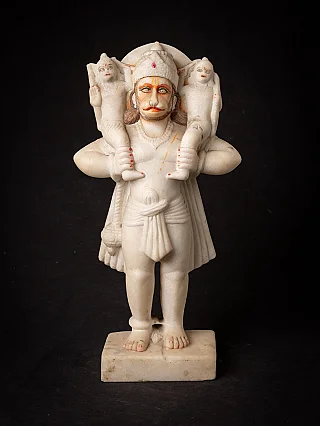
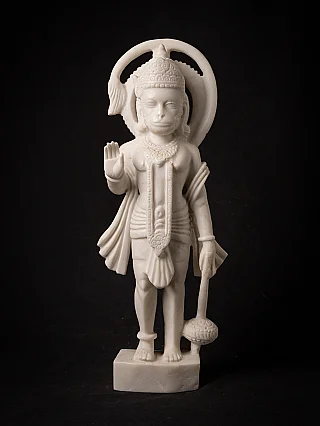
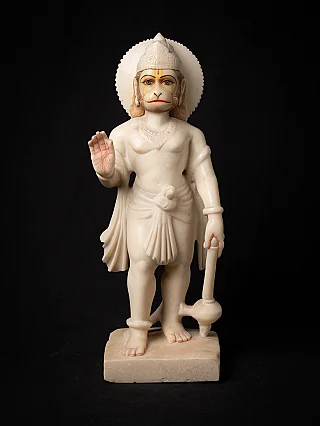
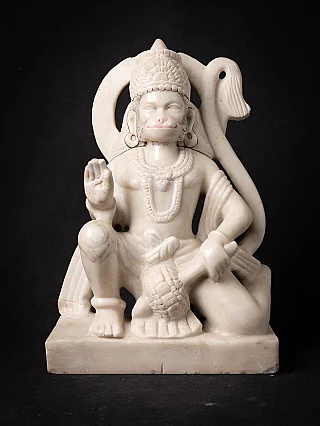
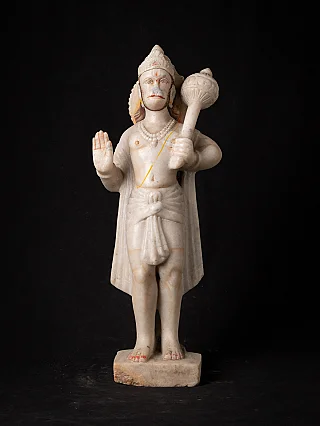
Who is Hanuman — theology, symbolism, and the Ramayana
Hanuman is the son of Vayu, the Hindu wind god, and Anjana, an apsara born into a monkey (vanara) lineage — a parentage that gives him his other name, Anjaneya. As a child, according to the Valmiki Ramayana, he mistook the sun for a fruit and leapt to seize it, an act of reckless divine strength that later defined his character. He is best known through his role in the Ramayana, the great epic in which he serves Rama — the seventh avatar of Vishnu — during the war against the demon king Ravana. Hanuman's feats in that story are the source of nearly every iconographic form in which he is sculpted: leaping across the ocean to Lanka, setting the city ablaze with his burning tail, and carrying an entire mountain — the Sanjeevani parvat — back to the battlefield to revive the wounded Rama's brother Lakshmana with its healing herbs.
Theologically, Hanuman represents the ideal devotee — the model of what Hindu philosophy calls the Karma Yogi, one whose spiritual realization comes not through renunciation or philosophical inquiry but through selfless service (seva) to the divine. He is also revered as a Brahmachari — a celibate, disciplined ascetic — which is why traditional practice holds that women should worship but not touch his image. Hanuman is granted immortality (Chiranjeevi) by Rama as a reward for his devotion, which is why, unlike most Hindu deities, he is believed to be still physically present wherever the Ramayana is recited. His other names include Bajrangbali ("the one with limbs strong as a thunderbolt"), Maruti (son of Maruta/Vayu), Sankat Mochan ("remover of troubles"), and Pavanputra (son of the wind).
The major iconographic forms of Hanuman statues
Hanuman appears in a smaller but no less distinct set of iconographic forms than the major Hindu gods, each tied directly to a specific episode or role from the Ramayana.
Veera Hanuman — the heroic, mace-bearing warrior
The most commonly sculpted form of Hanuman shows him as a warrior in dynamic posture — one leg forward, torso turned, the gada (mace) raised or resting on the shoulder, muscles emphasized to convey his physical power. This form is the direct visual equivalent of the Ramayana battlefield episodes, and it dominates temple gopurams (gateway towers) and freestanding devotional bronze across South India. In the Original Buddhas collection, Veera Hanuman figures appear primarily in bronze and carved stone.
Sankat Mochan Hanuman — the remover of troubles
This form depicts Hanuman in a posture of readiness or flight — often shown leaping, one arm extended forward — associated with his role rescuing devotees and armies from crisis, most directly the moment he flew to the Himalayas to retrieve the Sanjeevani mountain. Sankat Mochan is the form most frequently installed near entrance doors and thresholds, where his protective, obstacle-removing function is considered most active. A dedicated temple to this form exists in Varanasi, and it remains one of the most widely reproduced Hanuman images in contemporary devotional practice.
Panchmukhi Hanuman — the five-faced form
Panchmukhi ("five-faced") Hanuman is a composite, multi-headed form that combines Hanuman's own monkey face with the faces of Narasimha (lion, facing south), Garuda (eagle, facing west), Varaha (boar, facing north), and Hayagriva (horse, facing upward) — each face representing a directional guardian aspect. This form derives from a specific Ramayana episode in which Hanuman had to extinguish five lamps burning in five directions simultaneously to defeat the sorcerer-king Ahiravana, requiring him to manifest five faces at once. Panchmukhi Hanuman is particularly sought after by temple institutions and serious collectors for its directional protective significance, and it represents a meaningfully more complex commission for the sculptor than the single-faced forms — a fact that is generally reflected in price and rarity.
Rama Bhakta Hanuman — the devotee in namaskar mudra
This form shows Hanuman kneeling or standing with hands folded in namaskar mudra (the prayer gesture), often depicted tearing open his own chest to reveal images of Rama and Sita enshrined within his heart — a literal visualization of total devotional surrender. This chest-baring iconography is among the most emotionally direct images in Hindu sculpture and is popular for home altars, where the devotional rather than martial aspect of Hanuman is preferred.
Hanuman with the Sanjeevani mountain
A distinct narrative form shows Hanuman airborne or striding, carrying an entire mountain peak on his open palm or shoulder — the Sanjeevani parvat episode. This form is prized for its dynamism and is more commonly found in larger sculptural or relief work than in small devotional bronzes, given the compositional demands of depicting flight and mass simultaneously.
Hanuman attributes: reading the iconographic language
The gada (mace) is Hanuman's primary weapon and attribute, representing both his martial strength and his role as protector — it appears in nearly every form except the chest-baring devotional pose. His tail, often shown raised, coiled, or on fire, references the episode in which Ravana's court set it alight, only for Hanuman to use it to burn down Lanka's golden towers; a raised tail in a standing figure is a common shorthand for readiness and power. The mountain (when present) identifies the Sanjeevani episode specifically. Sindoor, the red vermillion pigment, is closely associated with Hanuman in contemporary devotional practice — according to a popular legend, he once covered his entire body in sindoor upon learning that Sita applied it to ensure Rama's long life, reasoning that more would grant Rama greater longevity still; painted or pigmented Hanuman figures, particularly in stone, often carry this reddish-orange coloring. His vanara (monkey) form itself is his primary identifying feature and is rendered with varying degrees of naturalism depending on region and period — South Indian bronzes tend toward a more anthropomorphized, muscular figure, while some Nepalese and folk traditions retain more overtly simian facial features.
Materials and regional traditions in Hanuman sculpture
Indian stone and bronze Hanuman sculpture — particularly from Tamil Nadu, Andhra Pradesh, and Karnataka — represents the oldest and most iconographically developed tradition, closely tied to the same temple workshop lineages that produced Chola-period Shiva and Vishnu bronzes. Sandstone Hanuman figures from northern and central India, often from temple gopuram fragments or freestanding shrine pieces, emphasize the Veera and Sankat Mochan forms. In the Original Buddhas collection, Indian Hanuman pieces appear in sandstone, marble, and bronze.
Nepalese Hanuman sculpture, primarily in bronze from the Newar workshop tradition of the Kathmandu Valley, reflects the same fusion of Hindu and Buddhist artistic influence found across Nepalese sacred art more broadly — visible also in the Vishnu and Parvati collections. Kathmandu itself maintains a living Hanuman devotional tradition — the Hanuman Dhoka palace complex takes its name from a Hanuman statue installed at its entrance gate in the 17th century, a direct architectural expression of his protective, threshold-guarding role.
Wooden Hanuman sculpture from Southeast Asia — Indonesia (particularly Bali, where Ramayana narrative carving is a major artistic tradition) and mainland Southeast Asia, where the Ramayana survives as the Ramakien in Thailand and the Reamker in Cambodia — depicts Hanuman with regional stylistic variation, often more animated and folk in character than the canonical Indian temple bronze tradition. These pieces frequently show him mid-narrative, engaged in a specific episode rather than in static devotional pose. See the stone statues collection and Cambodia statues collection for related Southeast Asian material.
How to assess a Hanuman statue before purchase
The first step is identifying which iconographic form is depicted and whether its defining attributes are present and correctly placed — a Panchmukhi figure missing one of its five faces, or a Sankat Mochan figure with an ambiguous posture, is a materially different (and typically less valuable) object than a complete example. Because Hanuman's forms are tied to specific narrative episodes rather than abstract theological principles, incompleteness is often easier to spot than with more symbolically abstract deities.
The face and posture are the primary quality indicators. A Veera Hanuman should convey coiled, forward-directed energy; a Rama Bhakta figure should convey stillness and surrender, not martial tension. A figure whose expression contradicts its posture — a devotional chest-baring pose rendered with an aggressive facial expression, for instance — suggests either a later composite piece or a workshop working outside its usual iconographic vocabulary.
For bronze Hanuman figures, assess the casting quality at the tail, fingers, and mace head — the most technically demanding and most frequently damaged elements. For stone figures, check the base and reverse for tool marks and wear consistent with the claimed age. At Original Buddhas, every Hanuman statue is described with a full condition report covering material, iconographic form, attribute completeness, surface quality, and estimated period and origin.
Where to place a Hanuman statue
Vastu Shastra tradition holds that Hanuman statues are most auspicious placed in the south or west of a home, facing north or east, and ideally at an elevated position rather than directly on the ground — never on the floor. He is especially popular near entrance doors and thresholds, where his protective, obstacle-removing character is considered most active; this is consistent with the Sankat Mochan and Veera forms specifically. A Rama Bhakta or namaskar mudra Hanuman, by contrast, suits a home altar or puja room, where the devotional rather than protective register of the image is more appropriate. Panchmukhi Hanuman, given its directional five-faced symbolism, is traditionally placed where it can be approached from multiple sides.
FAQ: Hanuman statues
Who is Hanuman and why is he worshipped separately from Rama?
Hanuman is the vanara (monkey) devotee of Rama in the Ramayana, revered for his strength, loyalty, and total devotional surrender. While he is inseparable from Rama's story, Hanuman is worshipped as an independent deity in his own right across India and Nepal — more temples in India are dedicated to Hanuman than to almost any other deity — because his qualities of courage, protection, and unwavering devotion are considered directly accessible and beneficial to devotees in daily life.
What is the difference between Panchmukhi Hanuman and standard Hanuman statues?
Panchmukhi Hanuman is a five-faced composite form combining Hanuman's face with those of Narasimha, Garuda, Varaha, and Hayagriva, each facing a different direction. It derives from a specific Ramayana episode and carries directional protective symbolism not present in single-faced Veera, Sankat Mochan, or Rama Bhakta forms. It is rarer, more technically demanding to sculpt, and generally commands a higher price than standard forms.
Are Hanuman statues at Original Buddhas antique?
The majority of Hanuman statues in the Original Buddhas collection are antique (over 100 years old) or vintage (50–100 years old), from India, Nepal, and Indonesia. Each listing specifies the estimated period, origin, iconographic form, material, and condition.
What do Hanuman statues cost?
Prices range from approximately €120–€350 for smaller vintage sandstone or marble figures to €800–€3,500 for significant antique bronze pieces with strong iconographic completeness and documented period attribution. Panchmukhi and other multi-faced or narrative forms (such as Hanuman carrying the Sanjeevani mountain), where available, occupy the higher end of that range. Each piece is priced individually based on iconographic form, material, carving quality, condition, and rarity.
Can a Hanuman statue be displayed by non-Hindus?
Yes. Hanuman statues are collected and displayed worldwide as objects of spiritual interest and artistic merit, as well as devotional worship. The primary consideration is respectful placement — at or above floor level, on a dedicated surface — regardless of the viewer's background. Traditional practice holds that women may worship but should not touch the image, reflecting Hanuman's status as a Brahmachari (celibate ascetic).
Which Hanuman form is best for a home entrance versus a puja room?
Sankat Mochan and Veera Hanuman, both associated with protection and obstacle-removal, are the traditional choices for entrances and thresholds. Rama Bhakta Hanuman, shown in namaskar mudra or the chest-baring devotional pose, is better suited to a home altar or puja room, where its focus is surrender and devotion rather than protection.
Do you ship Hanuman statues internationally?
Yes. Original Buddhas ships worldwide. Stone and bronze Hanuman figures receive specialist packing appropriate to their material, weight, and fragility, with insurance and tracking included on all shipments. Shipping costs are calculated individually based on weight, dimensions, and destination.
Hanuman statues at Original Buddhas
Original Buddhas is a specialist gallery for authenticated antique and vintage Buddhist and Hindu sculpture, based in Deventer, Netherlands. Our Hanuman statue collection spans heroic Veera bronzes, Sankat Mochan figures, rare Panchmukhi pieces, and devotional Rama Bhakta sculptures — in sandstone, marble, bronze, and wood — from India, Nepal, and Southeast Asia. Browse the full Hanuman statues collection, explore Vishnu and Shiva statues, the broader Hindu god statues collection, or contact us directly to discuss a specific piece.